

Showing posts with label intonation. Show all posts
Showing posts with label intonation. Show all posts
Saturday, April 13, 2013
Ear Training for Beginners (Plus "InTune!" App Review!)

Monday, April 9, 2012
Six Tactics to Improve Intonation
| Your ear is the final judge, but it doesn't hurt to have one of these on the stand. |
One of the most illusive pursuits is that of ensemble intonation. There were at least a handful of things that helped us and continue to help us improve in that regard. When the year started, all my band knew about tuning your instrument was that the previous director marked all of the slides etc. where they were supposed to be set, and if you left it there it meant you were in tune. Can you believe that? So we practically started from scratch. I doubt I'll get through everything in one post (entire books are available on the subject), but here are a few key tactics that I think got us on the right track.
Monday, March 26, 2012
5 Ways to Keep Scales Interesting
| Simple modifications to scales can help your band grow by leaps and bounds! |
One of the things I like to do in rehearsal is experiment with the warm up time. A while back I blogged about how to make your warm up time relevant for students, and today's post is closely related to that. There are plenty of ways to structure a good warm up, but I'm a believer that technique building should be included in there somewhere. I also believe scales are a fundamental building block for musicianship, not only for the music literacy and fluency, but for the technical aspects of playing. So we play scales every day. The problem with scales is that they can be very mundane. Fortunately, it can be remedied by adding in some variety. So, submitted for your consideration, here are a few ways to mix up your scales (both basic and advanced) to make them more interesting, fun (hopefully), and more relevant for students.
Saturday, December 3, 2011
3 Ways to Make the Warm Up Relevant for Students

The Problem With Most Warm Up Routines...
is that they're routine. On the one hand, routines and procedures are important. They help the students stay grounded, it helps them know what to expect, and so on. But here is the kind of routine I'm talking about:
Saturday, May 21, 2011
The Three Levels of Listening
Greetings!
One of the most difficult things to teach students is active listening skills. I was very fortunate in my early high school experience to have someone present a schema for listening to me that was easy to understand and apply. I've continued to use it as a player and a teacher with success.
For any readers who haven't taken Education courses yet, a schema is basically a model for understanding something that you create in your brain. For example, if you know the rules for the NFL, you've developed a schema. However, when you watch Arena Football, you have to adjust your schema (understanding of how football works) slightly to accommodate the different rules. It's also possible to have to develop completely new schemata when the information you discover cannot be assimilated into an existing schema. Moving on...
I don't know who came up with this, otherwise I would give them credit. The idea is that there are Three Levels of Listening. You focus your listening on specific things in specific levels, and when you have achieved certain things on that level, you move up to the next one while still monitoring what you've already worked on at the same time.
One of the most difficult things to teach students is active listening skills. I was very fortunate in my early high school experience to have someone present a schema for listening to me that was easy to understand and apply. I've continued to use it as a player and a teacher with success.
For any readers who haven't taken Education courses yet, a schema is basically a model for understanding something that you create in your brain. For example, if you know the rules for the NFL, you've developed a schema. However, when you watch Arena Football, you have to adjust your schema (understanding of how football works) slightly to accommodate the different rules. It's also possible to have to develop completely new schemata when the information you discover cannot be assimilated into an existing schema. Moving on...
The Three Levels of Listening
 |
| Developing active listening skills takes guided practice. It's like developing a seventh sense. (The sixth is Kinesthesis) |
Level One - Listen to Yourself
As teachers we understand that if a player does not sound good individually, it will be impossible for them to blend into the sound of the band. So, the first goal is to train students to listen critically to their sound and their playing, and to make adjustments. When you begin putting this schema into practice, you start with "Level One - Listen to Yourself".
There are certain check offs at this level (as with all of them). They're all related to individual playing. For example, "Are you playing with a good tone quality?" "Are you playing in tune?" "Are you playing with good articulation/style/musical shaping?" And you could go on. If they can answer "Yes" to all of these questions, then they move on to Level Two.
Saturday, April 16, 2011
Intonation for Beginners 2 - Daily Ensemble Training
Greetings!
 Last time I discussed how I introduced intonation to 6th graders. It was based on the idea of teaching them what to listen for, and how to react to it, and also based on the premise that they must learn to make this important musical decision for themselves ("Am I in tune? Here's what I need to do to get in tune"). It was mostly based on the work of Ed Lisk, with some visual aids thrown in. It took most of the class period to do after our warm up/technique building and scales work. But it was worth it. After that, what we chose to do was not so different, in many respects, from what you would do with a more advanced band. We incorporated tuning into our daily routine.
The Daily Routine
We chose to wait to tune until after our warm up and scales routine. This is similar to what the two directors do with their bands, except that we of course spend much more time with the beginners on technique building, sound building, and scale work. A daily routine might look something like this:
Warm Up from the Method Book
Scales (However many they knew at the time, which I had them play in the circle of 4ths one after another)
Chorale (Run it once)
Tune
Chorale (For Real)
Music
I'll get to the split chorale thing in just a second. First let's talk about the tuning exercise.
Reinforcing the Steps to Play in Tune
The tuning exercise itself was nothing spectacular, but I'll go ahead and run it down. The one I use is different from what the teachers I work with use. It's based on one of Ed Lisk's models. Essentially, we want to teach them who to listen for in addition to how to respond to waves in the sound. Two of the classes have multiple instrument groups in the same period, and when I worked with all the groups at once I would use a two phase tuning procedures.
In the first phase, only section leaders tune, starting with the lowest voice and working gradually to the highest voice. Once all the section leaders are in tune, then you cut off and start over with the lowest voice, but this time you bring in the rest of the section members, one at a time, and add one section at a time, until everyone is in.
Throughout the process you are reinforcing the steps to tuning discussed in the previous post to help them think their way through the process, particularly if you notice they're not making changes within the first few seconds of holding the note. This is important for section leaders and members.
The reason this works is because it teaches each student not only what to do when they hear waves, but also who they are responsible for listening to. Principal players must listen down to the lowest voice, while all other members must listen and match the principal player in their section.
It also provides a great model for the group when the section leaders are in tune, because then you can note that if the entire group is perfectly in tune, they will sound just as good, but with more volume.
The down side is that it takes time, especially when they're first learning the procedure. The first day we worked on intonation, it took most of the class period. The second day we reviewed the steps to tuning while also introducing this new procedure. It took a good chunk of time, but not as long as the first day. They were simply applying the skill in a different context.
I was worried that the tuning procedure I chose to use was too time consuming, but I stuck with it, and within a week we were zipping right through it. And boy was it worth it! Their listening skills improved quite a bit, and though they were not in tune on every note when they played their concert music, it was still much better than what they were doing previously. That also means that now when they're out of tune, it's painfully obvious to everyone, not just the teachers.
Using a Chorale
It's pretty common practice in bands with good intonation to use a chorale and to work on it every day as if it were a concert piece. Essential Elements 2000 incorporates chorales into its daily warm up sections. We didn't start using a chorale until about the time we introduced their contest music, and when we did it was not from the Essential Elements book.
We're using one of the Davenport Chorales, written by Mike Davenport. The big pedagogical feature is that everyone can see every part (the score, in other words) so they can learn who is important at different times. The chorales are also sequenced so that you can give them progressively more complex chorales to learn from. The one they're using is short and simple, both rhythmically and harmonically.
This allows us to more easily address balance and blend. With our low brass class we can balance the tuba, euphonium, and trombone sections. In woodwind class it's the saxophones (which we now have baritone, tenor, and three altos), clarinets and flutes. Then we have our high brass class. Horns were started later in the year, and are often on their own. When they're there I ask them to balance the trumpets, but when it's just the trumpets I take the opportunity to address how parts are balanced (with the higher numbers fitting their sound into the lower numbers).
The other thing I'll do on a regular basis is to have them play the chorale one time before we tune. I'll ask them to listen and remember what that sounds like. After we tune (regardless of what the tuning procedure is) we'll go back and play it again to see how much it has improved. My hope is that if they hear the difference it will motivate them intrinsically to want to play in tune all the time.
Advanced Intonation Skills?
For at least a few weeks now I have started and continued working with one percussionist in each class, so I know the tuning procedures have changed for the students (and the procedure depends on which of the teachers is running the class). But as we have continued to address this concept and reinforce the skills with them, they have continued to improve. The head director, my cooperating teacher, noted that their intonation is really good for beginning 6th graders. I'm proud that I introduced this musical skill to two of the three classes, and that the methods of both introducing it and reinforcing it have worked out as well as they have.
Don't get me wrong, they're not perfect at it, but they're pretty good and are still improving.
Of course there are other things that players must learn to do to play their parts in tune with the band aside from just getting in tune at the beginning. These students are also matching pitch better in their concert music, but we haven't necessarily taught them the skills to make adjustments as they play.
By adjustments, I mean "lipping up/down", "rolling in/out", "more/less mouthpiece" etc. etc. Eventually students must know the pitch tendencies for their instrument and know how to compensate for that without changing the length of their instrument.
But I'm not sure when you do that. It seems strange to me that you would ask beginners to monkey with things like their embouchure that early on, even for this purpose. I asked the teachers I am under about this, and when you introduce those skills, and they explained that they choose not to discuss that with their students at all.
I know that I knew a little about that as a high school student. My brass teachers would tell students what small adjustments to make when it wasn't a matter of the instrument's length. But the band I'm student teaching with is also very successful and has a very good ensemble sound without necessarily doing those things.
Regardless of your opinion on it, I know it can be done. At least with high school students. I suppose it's a decision you have to make in terms of whether or not to go there with students and at what point do you start introducing those skills, and how to do you teach them, etc.
But do you discuss these advanced intonation skills with beginners? I don't know, to be honest. I don't think you do, but I could be wrong.
What pedagogy have you used or seen used to teach students about intonation? I'd love to dialog about it in the comment section. Thank you again for reading, and until next time, take care!
Musically yours,
Mr. Cooper
Saturday, April 9, 2011
How Do You Teach Intonation to Beginners? - Individual Training in the Classroom
Greetings!
Well, it's been a while since I've posted anything. I'll explain why in the "P.S." section. Business first!
I'd like to start by saying that I've had an incredible student teaching experience so far. I've been able to work with students and run classes on a daily basis, and my skill level has dramatically improved. I wish I could stick around for another semester to learn about the details of marching season from the two teachers I work with, but what are you going to do?
Anyway, how do you teach intonation? I was lucky to have a tremendous high school band education as part of one of the top 10 concert bands in the state, and a couple of years with one of the top collegiate bands in the state. The intonation in both of these ensembles was top notch. The expectation is that you would play perfectly in tune, at all times. And we did... more or less. But we were also taught how to do it independently.
Band teachers typically use one of two tactics. Some will listen to a student and tell them what to do to get in tune, while telling them to listen and match the section leader. It works, and I've seen it work. And there are some really successful teachers that do this.
Other teachers tell students what to listen for, and how to react to what they hear, so that the decision making is no longer on the teacher, but rather on the student. My personal belief is that this is a better music education. I want my students to go on with the skills and knowledge to be an independent musician, in whatever capacity that might be. This requires that I don't just tell them what to do. Instead, I have to train their thinking.
It is possible to tell them what to do ("You're sharp, pull out."), and for them to develop the ability on their own. If the student is motivated, and smart, then they will eventually figure it out on their own. It happens all the time. What I'm about to share was developed by a leading educator and I believe it's a much faster route to the end of independent musicianship.
A couple of authors (at least) talk about this idea of teaching students how to think. In a clinic with John Whitwell, he recalled Elizabeth Green telling a room of graduate students, "You band guys are so good at teaching the lips and the fingers. When are you going to start teaching the brain?" Ed Lisk has several books (which I love, by the way) in which all of his tactics are based on teaching students how to think and make musical decisions.
I wouldn't have known to teach beginners about intonation unless one of my mentors at the school I'm student teaching at had told me to do it. He's a past Honor Band Director, so I take his advice as being solid. One day I noticed he was teaching the bulk of the woodwind class about intonation, at which point I said, "Well, I guess it's time," and set myself to teaching the other two beginning classes (low brass and high brass) how to do it. That night I reviewed some books and the next day I put it into practice.
The results have been very good! When you teach beginners what to listen for, almost all of them will hear it right away. For a few, it has taken some time to recognize the difference between in and out of tune sounds. But I'd say it's a very small percentage. For everyone else, when they heard waves in the sound for the first time, their eyes lit up, and they could identify it, and in varying degrees (fast waves, slow waves), every time afterwards.
Fast forward some weeks, now that the beginning band has met as a full group a few times and played through all of their festival tunes. They are playing with pretty good intonation and blend for 6th graders, and I can't wait to see how much better it gets in the 4 weeks until they perform for the public.
So what was the procedure I used? It's basically the procedure outlined in Ed Lisk's "Alternative Rehearsal Techniques" series, but with a couple of small changes. It's also the same method, I realized, that I was taught to use in high school.
I used a white board to draw a few images as I gave an explanation. I started by explaining that it is possible for two people to play the same note, but that it won't be quite the same. One person might sound slightly higher or lower than the other person, and that we call that sharp or flat. When that happens, you hear waves in the sound. "Waaa-waaa-waaa-waaa." It would look something like this (and I did the wave sound again as I drew the waves):

I continued, if the players are really far off from each other, you'll hear fast waves, kind of like this:
If the two players are really close to being in tune, the waves will sound slower:
But waves just don't sound good to us or to the audience. What we want is what we call, "Straight line tuning", which is a sound without waves:
P.S. So why the long delay in blogs? A lot of that is that I'm carefully considering the parameters of this blog, and boundaries for how I should write. I'm pretty sure I've followed the Texas Educator's Code of Ethics, but it seems that even if one does that, you can still cause discomfort when someone knows who you are and that you're talking about their student, or students. That's certainly not what I want. I want this to be a means to help myself improve, but I also want it to be a positive thing for others. I want it to be helpful, never hurtful, or even to cause anyone an ounce of stress. What I decided is that I want to continue to blog in a reflective manner that is open for everyone to read, so I'm working on figuring out how to do that with the above considerations. Don't be surprised if there are some changes to the blog once I decide how to procede in that regard. Thanks again for reading and take care!
Well, it's been a while since I've posted anything. I'll explain why in the "P.S." section. Business first!
I'd like to start by saying that I've had an incredible student teaching experience so far. I've been able to work with students and run classes on a daily basis, and my skill level has dramatically improved. I wish I could stick around for another semester to learn about the details of marching season from the two teachers I work with, but what are you going to do?
Anyway, how do you teach intonation? I was lucky to have a tremendous high school band education as part of one of the top 10 concert bands in the state, and a couple of years with one of the top collegiate bands in the state. The intonation in both of these ensembles was top notch. The expectation is that you would play perfectly in tune, at all times. And we did... more or less. But we were also taught how to do it independently.
 |
| As we all know, playing in tune is the difference between this... |
 |
| ...and this. |
Different Schools of Thought
Band teachers typically use one of two tactics. Some will listen to a student and tell them what to do to get in tune, while telling them to listen and match the section leader. It works, and I've seen it work. And there are some really successful teachers that do this.
Other teachers tell students what to listen for, and how to react to what they hear, so that the decision making is no longer on the teacher, but rather on the student. My personal belief is that this is a better music education. I want my students to go on with the skills and knowledge to be an independent musician, in whatever capacity that might be. This requires that I don't just tell them what to do. Instead, I have to train their thinking.
It is possible to tell them what to do ("You're sharp, pull out."), and for them to develop the ability on their own. If the student is motivated, and smart, then they will eventually figure it out on their own. It happens all the time. What I'm about to share was developed by a leading educator and I believe it's a much faster route to the end of independent musicianship.
A couple of authors (at least) talk about this idea of teaching students how to think. In a clinic with John Whitwell, he recalled Elizabeth Green telling a room of graduate students, "You band guys are so good at teaching the lips and the fingers. When are you going to start teaching the brain?" Ed Lisk has several books (which I love, by the way) in which all of his tactics are based on teaching students how to think and make musical decisions.
I wouldn't have known to teach beginners about intonation unless one of my mentors at the school I'm student teaching at had told me to do it. He's a past Honor Band Director, so I take his advice as being solid. One day I noticed he was teaching the bulk of the woodwind class about intonation, at which point I said, "Well, I guess it's time," and set myself to teaching the other two beginning classes (low brass and high brass) how to do it. That night I reviewed some books and the next day I put it into practice.
The results have been very good! When you teach beginners what to listen for, almost all of them will hear it right away. For a few, it has taken some time to recognize the difference between in and out of tune sounds. But I'd say it's a very small percentage. For everyone else, when they heard waves in the sound for the first time, their eyes lit up, and they could identify it, and in varying degrees (fast waves, slow waves), every time afterwards.
Fast forward some weeks, now that the beginning band has met as a full group a few times and played through all of their festival tunes. They are playing with pretty good intonation and blend for 6th graders, and I can't wait to see how much better it gets in the 4 weeks until they perform for the public.
The Procedure
So what was the procedure I used? It's basically the procedure outlined in Ed Lisk's "Alternative Rehearsal Techniques" series, but with a couple of small changes. It's also the same method, I realized, that I was taught to use in high school.
I used a white board to draw a few images as I gave an explanation. I started by explaining that it is possible for two people to play the same note, but that it won't be quite the same. One person might sound slightly higher or lower than the other person, and that we call that sharp or flat. When that happens, you hear waves in the sound. "Waaa-waaa-waaa-waaa." It would look something like this (and I did the wave sound again as I drew the waves):
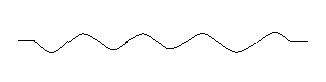
 |
| "Wa-wa-wa-wa-wa-wa" |
 |
| "Waaaaaaa-waaaaaa-waaaaaa" |
 |
| "Dooooooooooooooooooe" |
I also related it to a heart rate monitor and what it sound like when it flat lines. They thought that sounded like a bad thing, but I assured them that when you play in a band, that straight line sound is exactly what you want. Perhaps I should've stayed away from that analogy. =^)
So we dug into it. I explained the activity. The section leader would play and hold a concert F (which is what this program uses to tune to), and I would point to the next person to play and hold. I instructed all students to listen carefully for the waves, and see if they were fast or slow. I pointed to the section leader, and said, "Do you hear how her sound is a steady, straight line?" Then I pointed to the next student.
Waa-waa-waa-waa-waa!
Eyes lit up and several students said excitedly, "I hear the waves!"
I cut the two off and continued an explanation. We always assume that the section leader is in tune. The section leader's job is to tune to the lower instruments, and everyone else's job is to tune to the section leader. If you hear waves, you're out of tune and you need to make an adjustment...
First, make sure you are playing with a good quality of sound. Ideally you want to match the sound of the section leader. This might mean pushing more air, checking your posture, or adjusting your embouchure.
(This student was playing with a good sound, so I explained that I didn't think it was that, and went ahead and continued to the next part. If his sound were weaker at the moment, I would've encouraged him to make an adjustment and try again before going to the next step.)
If you're playing with a good sound and you still hear waves, you must check to make sure you're playing the same volume as the section leader and the people on either side of you. If you can't hear your neighbors, you're playing too loud. If you can't hear yourself, you may be too soft. Match the volume of the people next to you. Make sure you still have a good sound quality.
"Now try again and this time match her volume."
Waa-waa-waa-waa-waa.
(To the students) Are there still waves?
Students, "Yes!" and they started showing me the waves with their hands and so forth. I cut them off.
If you made those two adjustments and you still hear waves, then the instrument is out of tune and you need to make an adjustment. (Make the instrument longer or shorter), then play again.
Did the waves get faster or slower? If they got faster, you went in the wrong direction and need to go in the opposite direction. Did the waves get slower? Then you're going in the right direction, and you need to keep going. Does it sound like a straight line? Then you're perfectly in tune and it can't get any better. Memorize what that feels like and try to do it all the time.
"So make an adjustment and let's try again."
Wa-wa-wa-wa-wa-wa-wa.
Cut off, then to the student playing, "Were the waves faster or slower?" He wasn't sure. Other students answered, and I agreed with their answer, so I reminded him to adjust in the opposite direction and try again. We kept going until he was perfectly in tune with the section leader. When he got there, the students recognized it. I cut them off and said, "That was perfect! Good job!"
So then I had both of them playing and holding while the next person tried. We went through the same basic procedure, except that with me repeating the same things (again, telling them what to listen for and what to think/how to react to it), the process got faster with each student. When the class started getting waves in the sound before the student had a chance to tune to the group, I explained that air speed affects the tuning. Slower air makes pitch go down, faster air makes it go up, and that they have to keep a steady air speed and keep the embouchure in exactly the same place to keep the pitch steady. This advice was strictly based on my own experience. Eventually chops started to tire, so I had the section leader play and hold while everyone else listened. There were a couple of students we just couldn't get in tune. Cases like these were due to underdeveloped sound, or stuck tuning slides. In the case of the former I was gentle but honest in explaining that the sound quality was the likely culprit, but that it would improve with time (in other words, I was encouraging), and in the other case I explained to the student and the class the importance of maintaining equipment, and that it would be impossible to play in tune with a stuck tuning slide. After class we got it taken care of.
Reflections
One class had 14 students, and the other had 12-13 students, and it was an interactive but time consuming process. I initially didn't plan for it to take as long as it did, but considering they were beginner classes I should have. Ultimately it was worth losing most of the periods to cover this skill. After all, as one of my mentors said when I asked him how you teach this to beginners, he simply said, "Ear training." After a while it got a little boring for some of them. That's understandable. They're 11 year olds. But for the most part it was engaging until we got to the last 3rd or 4th of the class and we'd been at it for some time. But again, it was worth it. They could all now recognize when they were playing in tune, and they had some training on what to do to get in tune.
So how do you get through this in a larger class? I understand that many beginning classes, depending on the school size and situation, can be much larger. This is obviously best done in smaller groups to begin with. It probably wouldn't be smart to attempt this in a beginning class, for example, where you have all beginning band students in one class, and there are 50-60 of them. But we have to figure something out. After all, students need the chance to experiment and succeed, and they can't do that by themselves. Have you tried tuning to an electronic sound? It's not as easy to hear, unless you have something that is loud and in your range (which I never did). Students need to be trained how to think and react to make independent musical decisions, and the only way to give them that training is to give them the time and opportunity to experiment, fail, and go through the whole process until they achieve success (so they can memorize and hear the right way). You can show them the strobe, but this doesn't teach them to listen. And you can tell them what to do, which will get them more in tune with the other players, but it will make them dependent on you to tell them when they're out of tune and what to do when they're out of tune. Only certain students will achieve independence this way.
So we have to teach them what to listen for and how to react to make musical decisions, and then we have to give them the time to develop the listening and performance skills. It takes time.
When I implemented this strategy, and in the following days as we continued to review the concept, I was worried that it was taking too much time. We hardly covered any music the day I introduced this, which I was worried was a very bad thing. But now, several weeks later, I can see that it wasn't such a bad thing after all. They're still at the end of their book in addition to having learned four grade 1 band tunes, a short chorale, 7 scales, and a few other things. With a month to go (we're about to break out solo and ensemble materials for them), and with them playing with pretty good intonation skills for 6th graders, I'd say that time investment was well worth it.
Lately I've been working with percussionists in a different room from the main groups, but the other day I had a minute to listen to the low brass, and what I heard was very surprising. As they oompah'd their way through their quarter and half note accompaniment part, most of what they were playing was with straight line tuning. I only heard waves on occasional notes. It made me smile!
Anyway, the initial presentation is what I wanted to cover here. Of course there is more to it than this, but as far as introducing it to the group, that seemed to work out pretty well. I think in the next post I'll reflect on what happened afterwards to help them practice the new skills and build them up.
Ed Lisk has two other parts to his procedure. Once they're in tune he asks students to analyze whether they're pinching the tones, or loosening the embouchure, to get the note in tune. If so, he notes that the instrument is too long or short, respectively, and they need to make the proper length adjustment and return to their regular, relaxed embouchure. When they are in tune with their regular embouchure, then they're in tune. I didn't cover that with these guys. I've mentioned it once, I think, so I don't know if it's made any difference, or how it would've worked out had I mentioned it consistently. I would have, but honestly, I just forgot to include it. Drawing the straight line and varying speeds of waves as I modeled the waves with my voice as something I added on the fly, and it seemed to work pretty well. I like catering to visual learners.
Well, it was fun to look back on this. I spent a lot of time looking for ways to present it, and eventually settled on what you read above, and I'm happy with the results. As always, thank you very much for reading! Until next time, take care!
Musically yours,
Mr. Cooper
P.S. So why the long delay in blogs? A lot of that is that I'm carefully considering the parameters of this blog, and boundaries for how I should write. I'm pretty sure I've followed the Texas Educator's Code of Ethics, but it seems that even if one does that, you can still cause discomfort when someone knows who you are and that you're talking about their student, or students. That's certainly not what I want. I want this to be a means to help myself improve, but I also want it to be a positive thing for others. I want it to be helpful, never hurtful, or even to cause anyone an ounce of stress. What I decided is that I want to continue to blog in a reflective manner that is open for everyone to read, so I'm working on figuring out how to do that with the above considerations. Don't be surprised if there are some changes to the blog once I decide how to procede in that regard. Thanks again for reading and take care!
Subscribe to:
Posts (Atom)
