 Well, we're all right in the thick of contest preparation. It's been a while since I've had anything to say, but I thought I would share this quick motivation tip to help keep your band students going during this stressful, but (hopefully) most rewarding time of the year. It's the "Major Issues Remaining" countdown. Well, call it what you like, but here is how it works...

Showing posts with label motivation. Show all posts
Showing posts with label motivation. Show all posts
Monday, February 18, 2013
Countdown the Issues to Increase Motivation
Well, we're all right in the thick of contest preparation. It's been a while since I've had anything to say, but I thought I would share this quick motivation tip to help keep your band students going during this stressful, but (hopefully) most rewarding time of the year. It's the "Major Issues Remaining" countdown. Well, call it what you like, but here is how it works...
Saturday, November 17, 2012
A Motivating Pass Off System
 |
| On second thought, yes! |
In my first year of teaching I rarely used playing tests for beginners. I mostly did it for grades, and sometimes only once per grading cycle. I didn't understand how important it could be for motivation. Instead I wanted to use every moment of class time to learn new lines, and move as quickly through the book as we could, battling classroom management problems along the way. All of the good beginner teachers I know regularly have their students play for a grade. Over the summer I discovered a music pass off system that, it turns out, has worked wonders for student motivation, leading to students being more on task in class and an explosion of practicing outside of class. If you are like I was then, I hope this will encourage you to adopt a regular individual performance grade. If you already do regular playing test grades, then this system might interest you as well!
Wednesday, October 31, 2012
10 Motivational Strategies for Beginners
 |
| What does it take to be the Beginner Band Champion? Many hours of practice! |
Monday, June 4, 2012
Motivate Students With Long Term Goals
Friday, May 25, 2012
Journal Entry - "The First Year" 05/25/12
I've officially survived my first year! I feel like I saw an "Achievement Unlocked" pop up earlier, or at least felt one. I know I was in the middle of a series about student motivation, and I do want to finish that, but I also want to take a post to reflect on this past semester. Combined with some of my other entries this year and we'll have a pretty decent record of my experience this year: I Found a Job!, Thing Are Getting Better, Three Tips to Make Your Next Concert a Hit and Journal Entry 3-24-12.
In the last journal entry I talked about how I believed the band was hitting a major turning point. At UIL we made a 2 in Sight Reading and a 1 in Concert. The concert rating was significant because it was the first 1st Division in Concert Contest since 2009 for this group, also because we got a 3 at Marching Contest, and also because that meant they would get to perform at the UIL State Wind Ensemble Festival. It generated a lot of excitement, not just for the kids, but for the community as well.
In the last journal entry I talked about how I believed the band was hitting a major turning point. At UIL we made a 2 in Sight Reading and a 1 in Concert. The concert rating was significant because it was the first 1st Division in Concert Contest since 2009 for this group, also because we got a 3 at Marching Contest, and also because that meant they would get to perform at the UIL State Wind Ensemble Festival. It generated a lot of excitement, not just for the kids, but for the community as well.
Monday, April 23, 2012
Motivate Students by Achieving Short Term & Daily Goals
| Program preparation feels a lot like this, but every day counts. What do students feel they've accomplished when they leave each day? |
Monday, April 16, 2012
Motivate Students by Creating Structure

Tuesday, January 3, 2012
Three More Tips to Make Your Next Concert a Hit
| When I grow up, I want to play on a stage with that cool of a backdrop! |
Keep Dead Time to a Minimum
If there's one thing that kills momentum, it's the time it takes for one band to leave the stage while another one sets up and gets ready to go. Find ways to keep this dead time to a minimum.
Thursday, December 29, 2011
Three Tips to Make Your Next Concert a Hit
I recently survived my first winter concert, and I'm happy to report it was a smashing success. I'm in the of
rebuilding a program, and winter concerts in previous years were not taken very seriously. Students were allowed to dress casually and wear Santa hats on stage. The audience, from what I'm told, talked during the music. Kids and parents of younger bands left after their kids performed, leaving hardly an audience by the time the high school band took the stage.
My vision of a winter concert was completely different. In this small town, the high school band is as close to a professional symphony orchestra as they'll probably ever have. I wanted a concert with quality musical programming and an elegant presentation, or at least presented to the best of our ability. I poured a ton of energy into the presentation as well as the music, and it definitely contributed to the concert's success. Here are some of the things we did that you might be able to use, if you're not already doing them:
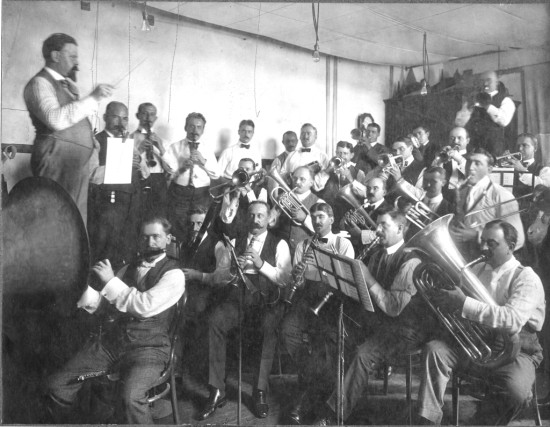 |
| These gentlemen understood how to put on a classy performance! |
rebuilding a program, and winter concerts in previous years were not taken very seriously. Students were allowed to dress casually and wear Santa hats on stage. The audience, from what I'm told, talked during the music. Kids and parents of younger bands left after their kids performed, leaving hardly an audience by the time the high school band took the stage.
My vision of a winter concert was completely different. In this small town, the high school band is as close to a professional symphony orchestra as they'll probably ever have. I wanted a concert with quality musical programming and an elegant presentation, or at least presented to the best of our ability. I poured a ton of energy into the presentation as well as the music, and it definitely contributed to the concert's success. Here are some of the things we did that you might be able to use, if you're not already doing them:
Thursday, December 23, 2010
Conducting: The Importance of Looking Up, Small Gestures, and Urgency
Greetings!
On my last conducting reflection I talked about some things that went well for me in my experiences. It's good to know that I have the basic tools and risk taking capacity to be an effective conductor. But I don't want to be an average conductor. I'd like to grow into one of those people who can communicate incredible amounts of information, whose conducting is at such a level that it elevates the abilities of the players in front of them. I expect that to take a while, of course, and a lot of practice. So, first on my list of things to improve on are as follows...
Don't Read the Score... Look Up!This was by far the worst of my mistakes. I spent a lot of time practicing with the score, eventually listening to recordings and trying to conduct from memory. But there is just something that is still a little intimidating about conducting a live group. A fear of missing cues, partially, or of losing my place in the score. I want to be a conductor that leads proactively through impulse of will and communication. I don't want to react to a missed entrance with a reassuring nod and smile. But even with Grainger's "Irish Tune", which should be easy enough to keep your place in, I still felt the need to look at the score more than I was looking up. I did a good job of making eye contact when I gave cues, don't get me wrong. But with all that time I spent looking at the score, I would be foolish if I were to complain that the players weren't paying attention. Right?
But a great thing happened when we played through "Shepherd's Hey". My worst fear came true - I got lost. We only had time to sight read, so there was no stopping. I flipped through a few pages while continuing to conduct a two pattern, but within a few seconds I decided there was no hope of finding where we were at, and I was wasting a precious opportunity to connect and make music.
So I looked up.
Not only did I start conducting from memory, but I experienced what Benjamin Zander calls going "Beyond the F*** It". In other words, I went all out.
I had practiced enough that I knew where we were, where we were going, and basically how we were going to get there, including some general style changes, a stop, an accelerando, and some other important details I wanted pulled out. When my wife watched the tape she noticed how much more I got into my conducting. Without me telling her what happened, her vocal reaction to the change was, "There you go, babe! Now you're getting into it!"
Not only did they hold together at close to performance tempo, but they actually did a pretty good job of style and dynamics. I totally missed a 3/2 bar, but they stuck with me.
It wasn't until the score was taken away that my true ability to communicate came out.
But this nemesis struck again when I worked with a public school band the next week. It was in the middle of finals week so I only had an hour and a half to study two scores, with recordings of neither one. I had a general idea of how each section sounded, but was not practiced enough to do it by memory, and as a result I spent a lot of time looking down. What a shame! We accomplished a lot through rehearsal, but I have to wonder how much more we might have accomplished through visual communication had I been looking up.
And then I recently came across something Peter Boonshaft wrote in his book, "Teaching Music with Passion: Conducting, Rehearsing, and Inspiring". He suggests that in the debate of conducting by memory or not, that we should have the best of both worlds. We should know the score well enough that we can conduct from memory, but admits that human memory is only so good, and we should glance at the score to recall previously learned information. The key word for me was, "glance".
In the future, I would like to be practiced enough that all I have to do is glance at the score to remember everything I need to know for that moment in time, and then spend the rest of the time looking around the room. It's tough. I'm sure it will get easier with practice. And certainly if I had 6-8 weeks of rehearsal as opposed to 15-36 minutes, that would also make all the difference.
 |
| I'm practically looking straight down! Would YOU be engaged? You know, because you've probably experienced conductors like this. |
So I looked up.
Not only did I start conducting from memory, but I experienced what Benjamin Zander calls going "Beyond the F*** It". In other words, I went all out.
I had practiced enough that I knew where we were, where we were going, and basically how we were going to get there, including some general style changes, a stop, an accelerando, and some other important details I wanted pulled out. When my wife watched the tape she noticed how much more I got into my conducting. Without me telling her what happened, her vocal reaction to the change was, "There you go, babe! Now you're getting into it!"
Not only did they hold together at close to performance tempo, but they actually did a pretty good job of style and dynamics. I totally missed a 3/2 bar, but they stuck with me.
It wasn't until the score was taken away that my true ability to communicate came out.
But this nemesis struck again when I worked with a public school band the next week. It was in the middle of finals week so I only had an hour and a half to study two scores, with recordings of neither one. I had a general idea of how each section sounded, but was not practiced enough to do it by memory, and as a result I spent a lot of time looking down. What a shame! We accomplished a lot through rehearsal, but I have to wonder how much more we might have accomplished through visual communication had I been looking up.
And then I recently came across something Peter Boonshaft wrote in his book, "Teaching Music with Passion: Conducting, Rehearsing, and Inspiring". He suggests that in the debate of conducting by memory or not, that we should have the best of both worlds. We should know the score well enough that we can conduct from memory, but admits that human memory is only so good, and we should glance at the score to recall previously learned information. The key word for me was, "glance".
In the future, I would like to be practiced enough that all I have to do is glance at the score to remember everything I need to know for that moment in time, and then spend the rest of the time looking around the room. It's tough. I'm sure it will get easier with practice. And certainly if I had 6-8 weeks of rehearsal as opposed to 15-36 minutes, that would also make all the difference.
Small Gestures
Not much needed here. One of my weaknesses has been a lack of small gestures, which hurts my dynamic contrast. My pattern during the softest sections of "Irish Tune" was probably a good mezzo-forte. They're playing wasn't too loud, though. The music is soft, but only because it is thinly scored. I don't believe 2-3 players need to play softly for the music to come across at the right dynamic. I think that's the approach I was taking. But generally speaking, I know small gestures are not something I do naturally.
The importance of having that range was reinstated when I recently attended Junction High School's Winter Concert. My friend Adrian Alonso, the director, did a fantastic job conducting them on Berlioz's "March to the Scaffold". At one point the full group was playing a soft volume, and Adrian's gestures were not much more than a twitching of the wrist for a measure, then an explosion of energy with the largest gestures he could make. The band's reaction was not disappointing, to say the least!
I've also been watching some great conductors to see how they convey soft dynamics in a variety of contexts. As eternal students of our craft, we are indeed fortunate to have YouTube, and videos of the world's greatest conductors within its database.
Time Flies, and You're Never as Good as You Wanted to Be
Pacing is something I'm getting better at, but it's still a weakness. I went into the Wind Ensemble rehearsal with a plan of how to use that 15 minutes. When I got on the podium I stuck to the plan. Roughly seven minutes on both "Irish Tune" and "Shepherd's Hey". By the time I got through the plan of action for "Irish Tune" I got a verbal cue from my teacher, "Three minutes." Wow! A plan for seven minutes turned into 12 minutes.
When I rehearsed the public school band the following week, it was much better. We lost some time at the start of class, ended up with 36 minutes to work with, and we used it pretty well. We fell short of getting through the entire second song by just several measures. Had we not lost that time at the start of class, we would've easily been able to run the work with its improvements and perhaps run through one of their other tunes, in addition to the time we spent working on legato playing during the warm up. Pretty productive.
Still, I wish I could have been better in both cases, and not just in terms of pacing, but everything. Even when I got to work with students at a school I observed at towards the end of the semester, I felt this way. I improved in a very short amount of time, and felt like I was certainly holding my own (except with the college group), but it seems it's never good enough.
But I think it also serves as good motivation for me. I know time is short, and I know time will fly by much faster than I think it will. Those are great motivators to be as prepared as I possibly can be. And while I'm improving all the time, I'll probably never be satisfied. Having a video tape of the Wind Ensemble rehearsal was painfully revealing (I really need a video camera for my first year). All of these experiences have continued to motivate me to search for answers and new techniques with a sense of urgency. No matter how much I discover, though, I never feel prepared, or good enough. I'm sure a lot of my music teacher friends out there can relate, though. I'm confident in myself, don't get me wrong, I just don't feel as prepared as I would like to be.
In the next couple of days I plan to post a funny video in the spirit of the holidays, but otherwise you won't hear from me again until after Christmas. Thank you for reading, happy holidays, and until next time, take care!
Musically yours,
Mr. Cooper
In the next couple of days I plan to post a funny video in the spirit of the holidays, but otherwise you won't hear from me again until after Christmas. Thank you for reading, happy holidays, and until next time, take care!
Musically yours,
Mr. Cooper
Saturday, October 23, 2010
Ideas to Create a Community of Learners, and Student Ownership
In this blog I mostly just want to get out some ideas I've had as the year has progressed and my education classes have made me think. I'd love to hear your thoughts about these. Sometimes I have great ideas, and sometimes they're crazy, and the bad news is that I rarely know the difference!
One topic I've read about deals with creating a community of learners. There are certain prerequisites, such as having a positive classroom environment (both in terms of the room's organization as well as good classroom management). But the idea is that you take the focus away from yourself as the teacher, and focus on student centered activities. This involves less lecturing and individual practice, and more group activities and discussion. Everyone is learning, including the teacher, and everyone helps each other to learn.
There are a LOT of things they talk about in education classes that band pretty much has built into it. But I think in regards to this one, I'm not so sure. Traditional rehearsals are entirely grounded in the idea that when you're not playing, you're not talking, and you're devoting 100% of your attention to the conductor, even if they're not talking to you, else you'll face the wrath. Of course, as players we always find ways to communicate, whether it's whispering extremely quietly, or whatever. When conductors are dictators, students find ways to bend those rules, even if just a little bit. At least that's my experience coming up in bands with that kind of environment. And hey, it works.
But what if there were more ways to make students responsible for each other's learning, and thus improving their learning in the process? Specifically, teaching a concept has the highest retainment rate and helps you to achieve a deeper level of learning than does anything else. So what are some ways to better create a community of learners and give students more ownership? I wonder how some of these ideas would work out.
Marching and Playing Fundamentals
My typical experience of marching techniques involves an explanation/demonstration of a marching technique by an instructor, with guided practice by the instructor in a block. Following that you'll usually break into sections, and the section leaders drill the new technique while giving the section more individualized attention. The ratio of officer to section members varies, of course, but it's better than the large block. Notice that the section leaders are now teaching, which increases their understanding and ultimately helps them become the stand out marchers of the band. After several minutes you'll return to the large block and drill some more. Some teachers have one group of students watch another, whether it's through the form of a section contest, or whatever kind of contest. This can be useful as you can see what makes someone look good or bad, but there is no guarantee that all students will watch intently. Though when you make a contest out of it, those chances do increase.
What if we were to do something like this? After reviewing previous techniques, we teach them the new technique and drill it for several minutes in a group setting. Then we number the columns or rows in 1's and 2's. Students turn towards their partner, introduce themselves, and then fall back into attention. We can then have the 1's fall out and watch the 2's display the technique, reminding them before hand of the check list of things they should look for, and with a previously instilled attitude concept that says they are ultimately responsible for the band's total success, and that every one of them really is a vital member of the band, along with some tips on how to give and receive constructive criticism (again, a safe environment is a prerequisite for establishing a community of learners).
Now what happens? Now we have a student teacher ratio of 1:1. The 1's are getting a deeper understanding of the marching techniques by not just watching it, but teaching it, and the 2's are getting one on one attention to help them improve. I think we could have the 2's display the technique a total of three times, with feedback after the first two. As soon as they stop, 1's assume the position of attention, and then 2's become the teachers. Having just had comments on their technique, they'll be even better prepared to coach the 1's (this seems unavoidable). We could even have the students shake hands or hug afterwards and say thanks for the help. We could either drill as a large group again to assess the total progress to that point, or go straight to sectionals where the section leaders, who have more training and probably better trained eyes (and probably higher expectations) will try to catch anything that was missed. Then we can still conclude with a giant group block at the end to review. I'd also be willing to instruct students to stand between two different people at each session so they're getting coached and coaching people they're unfamiliar with.
And yet there would be an element of urgency to this process, and a sense that students should be grateful for each other's help, because I am a big believer in having a marching certification process. For anyone who is unfamiliar, marching certification is like your marching techniques final exam, where you march through an established drill (ex: series of box drills), and demonstrate perfect marching fundamentals. This is with the threat (I hate to say it) that they must be certified to have a spot on the field during the half time show. The sequence should be challenging, but achievable, so that it is doable by everyone, but there is a real sense of accomplishment at the end. Then you do whatever it takes to make sure every student passes certification. Those who get certified right off the bat can root on those who are still trying, and can even coach students who are having significant trouble. The goal for an entire session is to pass certification, and you stay behind at the end of the day to keep working with anyone who couldn't do it in that time period.
Regardless of how hard it is, you hype it up as being a challenge. With this test of skills on the horizon, I think students can bond together with the common goal of helping each other to get through it, even on a one on one level. My only concern is that some students will be less experienced and knowledgeable than others, but rotating partners at each session should help to lessen the impact on any one student and give all students a more consistent experience. I don't know, I just think it could work.
I've also heard of a similar approach to teaching playing fundamentals in beginning band, such as having partners check each other for posture, horn carriage, etc. I don't think you can use this in all situations, but I think it would work well for certain things.
I went into much more detail on that than I had intended.
In Music Rehearsal?
I honestly think the most important thing you can get the students to do to improve during rehearsal is to motivate them to focus on improving at something no matter what's going on. For example, when I work with a group I say up front that if I start addressing one section, I expect the students not in that section to do something to get better. They can mentally count rhythms, finger through passages, etc. etc. There is music to memorize, and much to be done in general, and because time is the one commodity we never get back, they shouldn't waste a moment of it just because I'm addressing a section or an individual.
However, I think it's still somewhat possible to have a "community of learners" in the context of rehearsal. But you have to sacrifice something. Silence. Now this one I'm still undecided on, and I will probably arrive at a conclusion within the first couple of years of teaching, but here is what I'm debating. Actually, I tried this out over the summer and generally liked the results.
I gave the students permission to talk, but with certain restrictions. Above all else, they had to restrict their discussion to music related items. This way, if someone needed help (like a fingering or rhythm question), they had my permission to ask a neighbor before asking me. I figure the most problems they can fix on their own, the better for all of us. They were required to use the softest voice possible so that I could still communicate with who I needed to. If I could not communicate easily with who I needed to, I could remove that right. Finally, they could only ask each other questions if I was addressing someone else. If I was addressing them, I required their full attention.
You sacrifice the complete silence that most directors cherish. But silence is an interesting thing. Some students are able to focus better in complete silence, while others (particularly those who have enough siblings and animals at home) concentrate better when there is at least a little bit of ambient noise. So as long as the noise is of a low level such that I can easily communicate with who I need to, I don't think it hurts me. Silence or noise? Either way, some students are better off than others. If the noise level gets too loud, enforce the whisper rule, and if it happens again, enforce a "talk out". For non-WT people, the idea of a "talk out" is that, once enacted, only the director may speak a word. The consequences for uttering even a syllable during a talk about are apparently severe, though I never asked what happens. Everyone just shut up and I assumed if I talked I would get kicked out of band or something. I could just as easily have a student immediately put their instrument away and exit the ensemble formation, and call home after class. So through this concept it might be possible to create a community of learners even in music rehearsal, even if it was more limited. Maybe this will end up being totally wrong. But as long as the general rule is that they quietly stay on task individually until a question arises, I think it could work. Certainly a mad house is unacceptable. I've seen directors work in such an environment, but I can't imagine how, and the bands themselves were usually not that great. Of course, almost all of the talking was not related to the task at hand. But that kind of volume just plain made me angry. Anyway, I guess we'll see.
Other ideas to promote student ownership...
Have you ever considered that most subjects have student tutors, but band doesn't? Granted, even your best players have bad habits that you don't want them to pass on, but at the same time they could still offer some valuable help. I know in my high school tuba section, we traded tips all the time. In large enough cities you might have a small army of lesson teachers, but not all students can afford that, and I rarely see Jr. High/Middle School students taking lessons. Worse, what do you do if you're in a small town where no lesson teachers are available? Well, of course you can set aside some time each day to teach a private lesson or two, but you'll probably give priority to your older students, or at least those in the high school.
Keep in mind this specific idea is for small school bands, where often the Middle School and High School are merged onto one campus.
Why not have students from your top band, who are willing, able, and (based on your judgement) capable, teach lessons to beginning band students? Call them Band Tutors. Let your high school students know that these players are the future of the band, so the more help we can give them, the better the band will become when they become members. In larger areas with middle schools that have students start in the 6th grade, with 7th and 8th graders split between two skill based bands, you might still be able to find students willing to tutor beginners, but I don't know. Maybe, maybe not. But that first year of band is covering material so easy that it should be easy for even 8th graders to coach their 6th grade peers, as long as they've been well taught.
White sheets - of course. Ben Zander, conductor of the Boston Philharmonic (among other things), promotes a practice in which students answer the following question on a blank white sheet at the end of rehearsal - "What can we do to make more beautiful music?" For students, it might be that they need a cue, or need more help with a passage. But ideally what you want is feedback on the interpretation of the music itself. It might be a beautiful chord they want held out longer, or something else. You can then read over the suggestions and pick the ones you're interested in experimenting with the next time you hit those sections. With this practice, the end result is more of a collaborative effort than strictly the interpretation of the conductor (though that is the heaviest influence). Using student recommendations that are appropriate gives students a stronger feeling of ownership and pride in the music, in addition to having given them more liberty to exercise their artistic creativity.
As this has turned into a long post already, I'll conclude with these two brief ideas.
One question I've asked myself is how we can use the high school band to help support social causes both as a means for student intellectual growth as well as to build support among the community. I recall my high school band doing a food drive at least once, and at the concert the director explained that it had come from the band members and shook hands with the director of that organization on stage. Sure, it could be something as simple as that, or preferably we could maybe perform at an event or offer some volunteers or something. I'm not sure.
But what I'd like to do is compose a list of local organizations that advance various causes. At some point during the year I could give this list, with a description of the organization's purposes, to the students with instructions to read about the organizations and causes. At some point towards the end of the year we could take some time to vote on which organization(s) the students want to support in the next year. We narrow it down to 1-2, and then I can get in touch with those organizations to see how we could get involved. This way, not only are we building a positive reputation and positive connections throughout the community, but the students are learning positive values in the process, and have ownership over which causes the band supports. Hopefully it will involve a performance of some type, but that might not always be the case.
Finally, I'm also interested in having students choose the theme for the marching show each year. I'm currently preparing for the event that, like most other ASU music grads, I'll end up with a job as a director at a small school (though I wouldn't mind a job working with beginners in a large area, as I think it would benefit me more in the long run). With that in mind, I'm gradually piecing together a show, just in case that happens. But after that first year I could let the students help with that. My instructions would include paying more attention in their core classes to discover the underlying lessons and themes that can apply broadly to benefit us as Americans, or as a human race. For example, a student studying World War II in history, or related literature in English, may discover some important lessons about the evils of oppression. If the theme of oppression (not a show title, but a theme... part of the show's message) made the final cut, then I could go forth and find music that suited that theme. Shostakovitch or any number of composers would have great music that could be applicable to such a theme. I would provide guidance through the elimination process, but the end result would be based on what the students wanted the show to convey. Then I could go find the music and put the show together. This way the students get at least a small amount of ownership at the ground level of the show, while I still do the most important aspect (at least in my view), programming. But just this small thing makes the show their show, their message, and so on.
Well, that's a LOT of ideas I've thrown out there. What are your thoughts? Are any of them good? Or are they crazy? Your feedback is always appreciated. Thank you, as always, for reading, and take care!
Musically yours,
Mr. Cooper
Subscribe to:
Posts (Atom)
